By Pete Kinsey
AMO Great Lakes Representative
The Great Lakes navigation season came to a close on January 15, 2026, when the thousand-footer American Spirit completed the final passage through the Soo Locks in tough ice conditions.
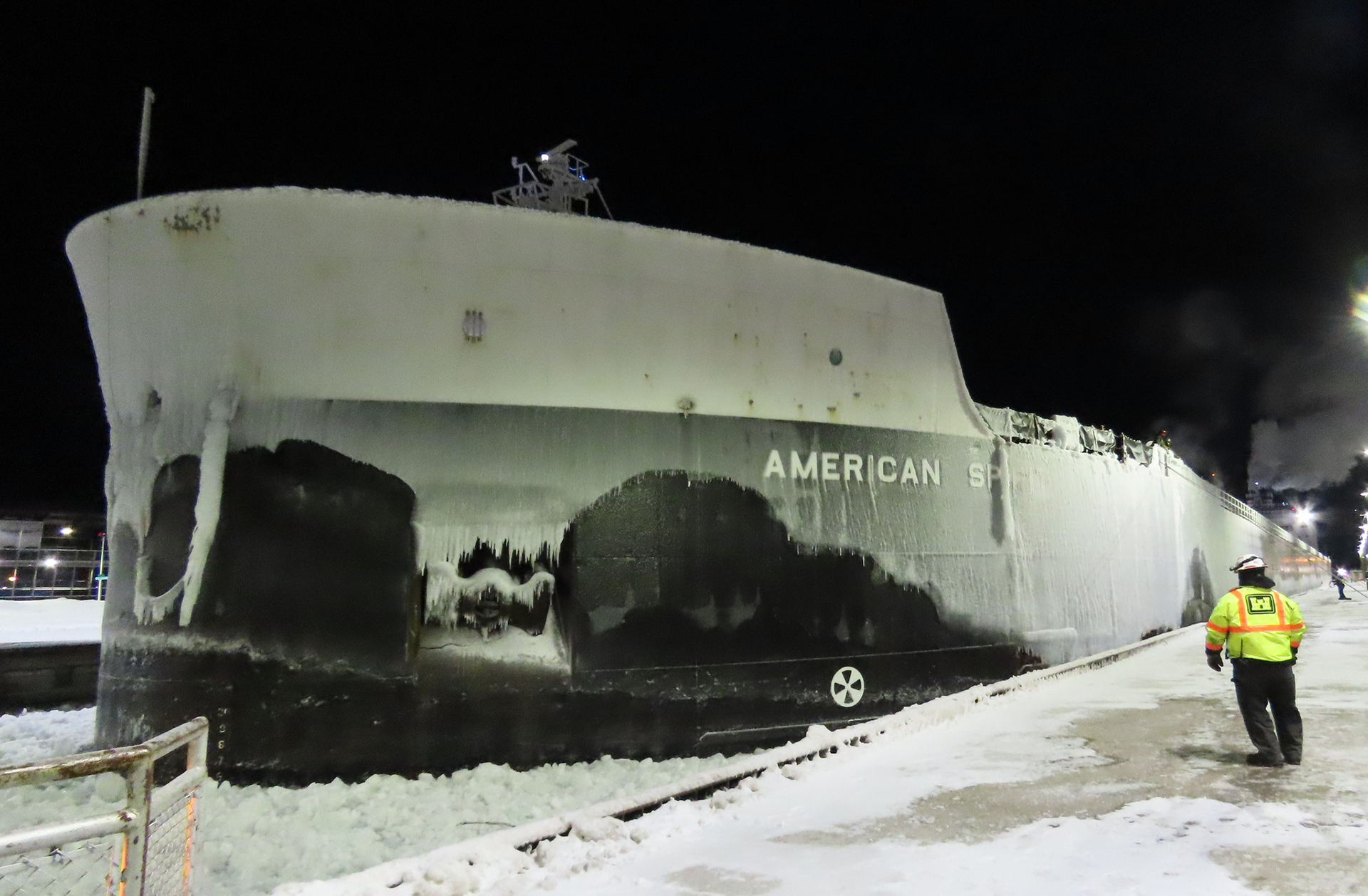
The American Spirit completed the final passage through the Soo Locks on January 15 to close the Great Lakes navigation season. American Maritime Officers represents all licensed officers aboard the American Spirit and the SIU represents the unlicensed crew members (photo: U.S. Army Corps of Engineers, Detroit District).
Just before 5:30 p.m., during a brief snow squall in Sault Ste. Marie, Mich., the vessel made its way under the International Bridge while carrying 51,438 tons of iron ore pellets loaded at Two Harbors, Minn., bound for Conneaut, Ohio. The lockage required three hours because of heavy ice in the approach canal and lock chamber, highlighting the challenges that defined the season’s end. The American Spirit departed around 8:30 p.m., and the U.S. Army Corps of Engineers, Detroit District, officially ended commercial traffic through the locks. The Soo Locks were closed on that date at 11:59 p.m. for annual maintenance.
This final transit followed a day of downbound vessels hurrying to meet the deadline. The Soo Locks serve as a vital link for Great Lakes shipping. The seasonal closure, which usually runs from mid-January to late March, allows the Army Corps time for necessary repairs on key fixtures, such as the Poe Lock, which is set to reopen March 25, and the MacArthur Lock, scheduled for reopening in late April. Throughout, work will continue on the new project to build a second Poe-sized lock.
The transit of the American Spirit, built in 1978 and operated by American Steamship Company, provided a representative conclusion to a season influenced by disruptive ice conditions across the system.
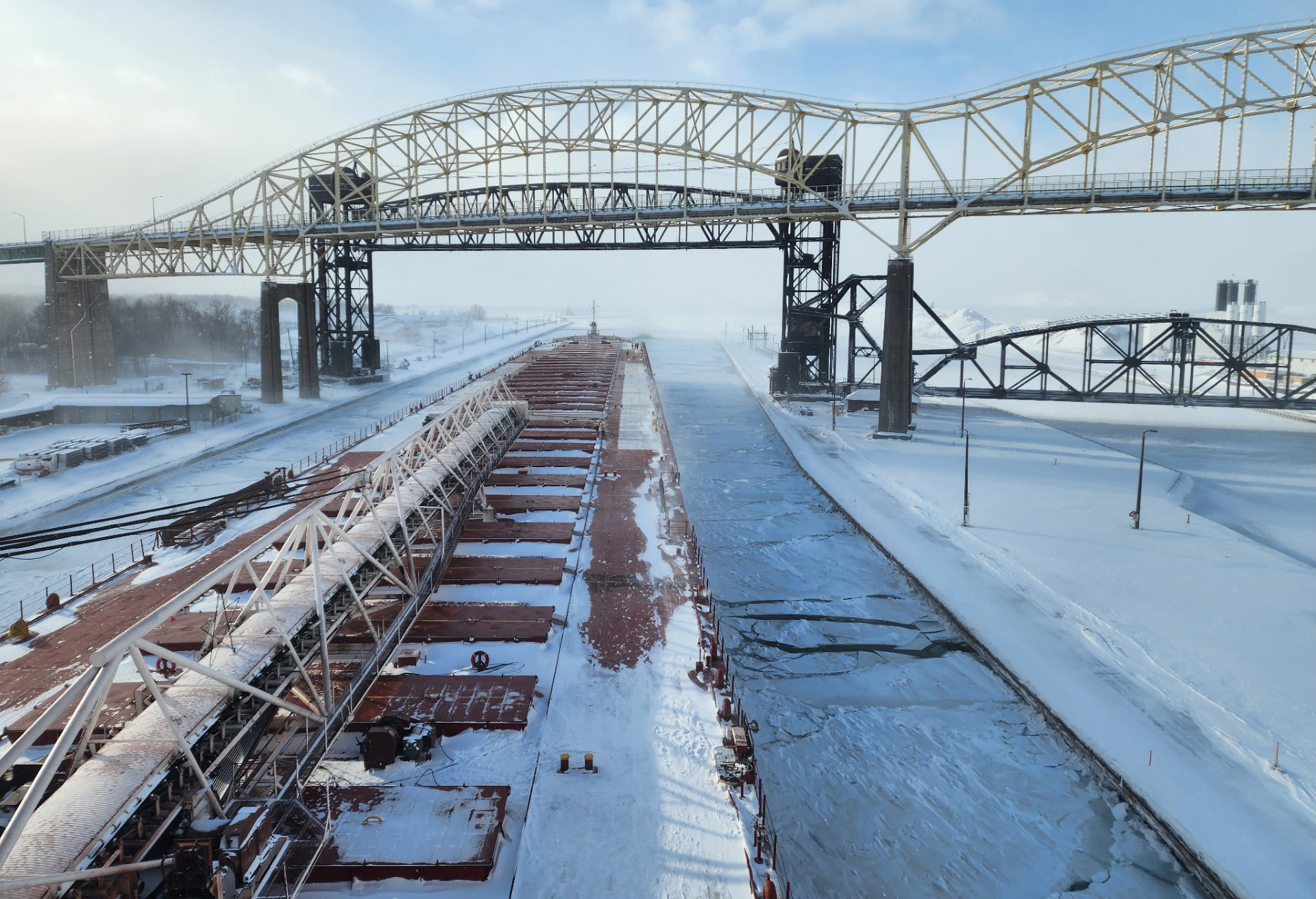
The American Century upbound in the Soo Locks in January – AMO represents all licensed officers aboard the American Steamship Company vessel (photo by Captain Alexander Bergel).
The circumstances reflect the wider difficulties of winter navigation on the Great Lakes. The U.S. Coast Guard has used operations, such as Coal Shovel and Taconite, to position icebreakers like the USCGC Mackinaw to keep channels open – even as shippers and industry groups have raised concerns about delayed responses, limited resources, and minimal support from Canadian partners. Although ice levels were not extreme this season, the early shift in December, fueled by rapid lake temperature drops and wind action, did create major interruptions.
The season’s end reminds everyone of the ongoing effort needed to keep this essential maritime route functioning through spells of severe winter weather.
The U.S. Coast Guard initiated Operation Coal Shovel on January 2, focusing on southern Lake Huron through the St. Clair-Detroit River system, Lake Erie, Lake Ontario, and portions of the St. Lawrence Seaway. This follows Operation Taconite, which began in mid-December for Lake Michigan and Lake Superior. Both operations involve the heavy icebreaker USCGC Mackinaw, 140-foot icebreaking tugs, and an ice-capable buoy tender, with coordination from the Canadian Coast Guard (CCG) to maintain navigable routes.
However, shippers and industry groups reported that ice formation, while not extreme this season, arrived earlier than anticipated in December and caused significant disruptions. The rapid plunge in lake surface temperatures in mid-November 2025 – driven by cooler-than-average air (one to two degrees Fahrenheit below normal) and strong winds bringing colder deep water to the surface – contributed to the quick onset. As a result, Lakes Erie and Ontario fell below normal, while Lakes Michigan, Huron, and Superior remained slightly warmer than long-term averages.
Critics of the icebreaking response pointed to the USCG’s delayed completion of the annual removal of floating aids to navigation before ice could damage or displace them. This mission, which took priority, delayed the deployment of icebreaking assets to assist commercial traffic, including holding back the USCGC Mackinaw until buoy removal was finished.
The Lake Carriers’ Association highlighted the fact that the USCG’s fleet of nine ice-capable vessels is stretched thin, with two dedicated to buoy maintenance and others affected by mechanical issues. The absence of additional heavy icebreakers and the aging 140-foot tug class have left the service struggling to balance navigational-aid removal with timely icebreaking support.
The Canadian Coast Guard had not deployed any icebreakers on the Great Lakes proper this season, with two vessels operating in the St. Lawrence near Montreal and a third docked in Sarnia, Ontario, due to engineering problems. U.S. vessels calling at Canadian ports continue to pay icebreaking fees despite receiving no assistance from CCG assets.
The St. Marys River experienced a temporary closure due to shifting ice displacing aids to navigation, and congestion built up in several areas, including the St. Lawrence Seaway.
The Great Lakes shipping system remains vital to the U.S. economy, transporting more than 90 million tons of cargo annually, including iron ore, coal, stone, cement, grain, salt, and other bulk materials that support infrastructure, energy, and manufacturing.